Your team has an AI assistant. Most use a fraction of it.
Most AI adoption stops at prompt, paste, hope. ADLC turns the assistant you already pay for — Claude Code, Copilot, Cursor — into a repository-native delivery process: governed stages, human approval gates, and delivery metrics you can put in front of the board.
45-min intro call · no commitment
Built for CTOs, VP Engineering, and delivery leaders whose teams already use AI — and who want proof it changed delivery.
Not a separate platform
Every stage is a declarative file in the repository — versioned with the codebase, reviewed like code, and travelling with the project. Runs inside Claude Code on the subscription your team already has — not through metered API calls.
Human-governed by design
AI supports execution, but architecture choices, commits, pull requests, and release decisions remain human-controlled.
Measured delivery flow
Throughput, cycle time and WIP — plus code quality from your own analyzers and who on the team actually runs the workflow — become visible, so teams improve with evidence.
Everyone has an AI assistant. Almost nobody runs it at full power.
Your engineers have Claude Code, Copilot or Cursor open all day. Most of that usage is still a chat window: paste some code, ask for a fix, accept the suggestion, move on. The rest is vibe coding — the agent writes a feature from a one-line prompt, nobody really reads it, and the rework lands two sprints later. Both feel like AI adoption. Neither changes how the team delivers.
We do not swap your assistant for another one. We make it run a real engineering process — and move the focus from individual AI productivity to the performance of the entire delivery system.
highly trust the accuracy of what it produces. 66% say the output is “almost right, but not quite”.
Experienced developers in a randomised trial believed AI sped them up. The stopwatch disagreed.
more likely to copy-paste than to refactor. Duplicated code blocks are up 81% since 2023.
“AI doesn’t fix a team; it amplifies what’s already there. … Without robust control systems, like strong automated testing, mature version control practices, and fast feedback loops, an increase in change volume leads to instability.”
Proven in a real enterprise software project with delivery metrics
ADLC was implemented in real production engineering environments, not a demo. The first full implementation supported a U.S.-based company in the insurance sector across three projects, becoming a repository-native AI-assisted delivery workflow and later evolving into a broader operational model for scaling engineering execution.
Steps: Ticket → Commit
Specialized Agents
Governed Workflows
Throughput Progression (Items/Day)
Baseline throughput before the structured AI-assisted workflow was introduced.
Throughput increased after the workflow became part of daily engineering execution.
Delivery remained high even after part of the team was redeployed, suggesting flow efficiency rather than staffing effect.
Throughput (Delivery Pace)
28-day rolling average of accepted work and completed work from the source dashboard.
Building full features with a small team: ADLC at uQualio
uQualio is a Danish video eLearning platform (EdTech SaaS). Like most vertical SaaS companies, uQualio has a roadmap that is always bigger than its engineering team.
Not another coding assistant, but a workflow that covers the whole path from ticket to pull request, with a human in control at every critical step.
Read the case studyFour ways teams use AI. Only one of them is a process.
Most engineering organizations we assess sit at level 1 or 2 and consider AI adoption finished. The distance between level 2 and level 3 is where delivery metrics actually start to move.
Copy & paste
Code travels to a browser tab and back by hand. Context dies with the conversation and nothing reaches the repository.
Autocomplete
The assistant finishes lines and small functions. A real speed-up — strictly per developer, and invisible in your delivery data.
Vibe coding
A one-line prompt produces a whole feature. Impressive until review — untested, unread, and expensive to unwind once it is in main.
Governed process
The same assistant runs a defined workflow: ticket, plan, implement, tests, review, human-approved commit. Versioned in the repo, visible in the metrics.
The tool was never the bottleneck.
Teams at L1 and L2 are running the same assistants as teams at L3. What separates them is the workflow around it: which stages exist, what has to be true before a stage closes, and where a human has to say yes. That is exactly what we build with you — and it is the part no licence includes.
Already doing this? Five questions.
Five questions, one per thing that has to be true before AI usage counts as a process. Each has a checkable answer, and each maps to a specific gate in ADLC — so a “no” tells you exactly what is missing.
Three or more “no” answers is the normal result — including at teams that use their assistant well. The usual shape: governance yes, the two gates no, baseline no. That shape is the gap between AI adoption and AI delivery.
Is there a file in your repository that says what the assistant is allowed to do — permissions, not coding style — and would a reviewer notice if it changed?
Counts as yes: a committed permissions or rules file that goes through review. Does not count: a conventions file about naming and formatting, a wiki page, or one engineer's personal prompt.
Does a person approve the approach before the assistant writes the code — enforced, not just requested?
Counts as yes: a plan stage the agent cannot skip past without a human. Does not count: the habit of asking it to explain first, or reviewing the diff afterwards.
Before the assistant hands work back as done, does something force it to build the code and run the tests?
Counts as yes: a gate the agent cannot skip. Does not count: CI catching it after the push, or a line in the prompt that says please run the tests. Two in three developers say AI output is “almost right” — the gate is what catches the “not quite”.
Do two engineers get the same process from the assistant — same stages, same checks — or does each one prompt it their own way?
Counts as yes: the process is defined in the repository and the assistant executes it. Does not count: shared prompt snippets, a page of tips, or a practice that lives in one engineer's habits.
Do you know your throughput from before AI — as a number?
Counts as yes: items per day or per sprint, from a tracker, for a period before adoption. In METR’s trial developers felt 20% faster and measured 19% slower — the feeling is not a metric.
A framework for defining governed engineering workflows.
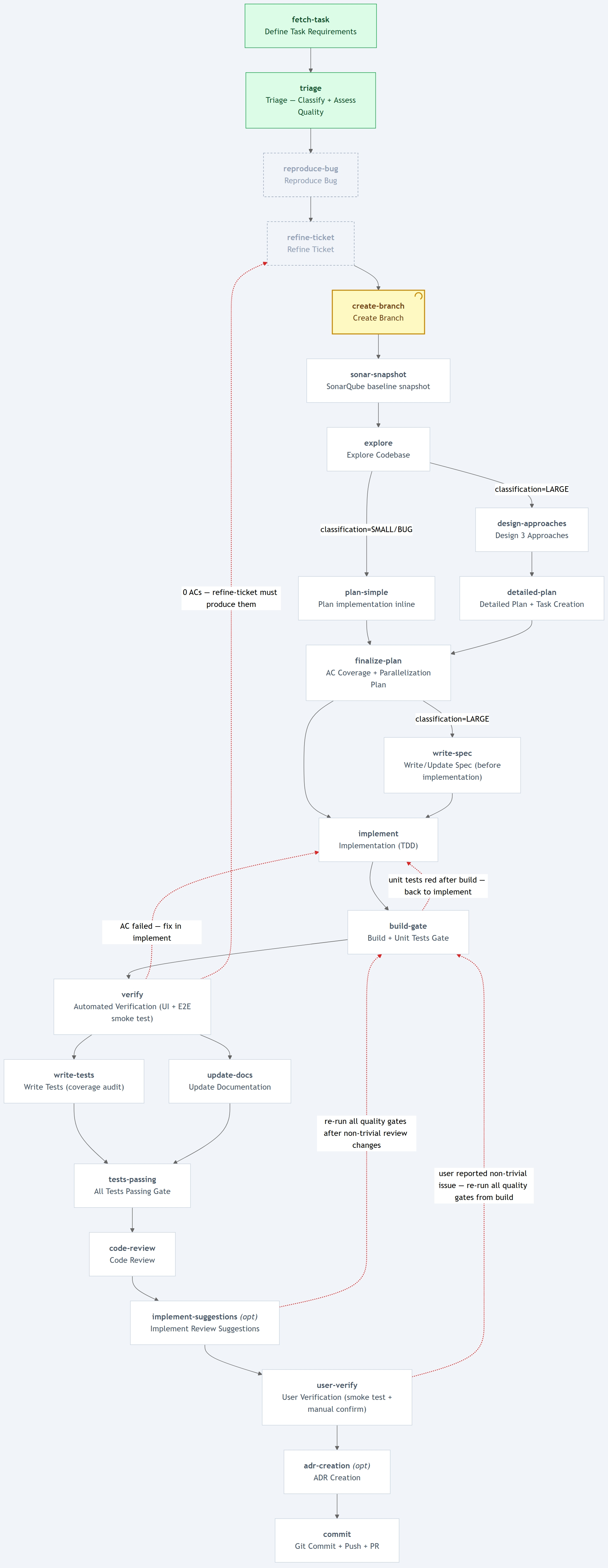
ADLC is not a single hardcoded workflow. It is a framework for defining and evolving repository-native engineering workflows with AI-assisted execution, governance, delivery metrics, and human approval gates.
The workflow shown here is one example: a path from ticket to reviewed and tested code ready for commit.
We build it for Claude Code, because that is where hooks can enforce a gate rather than politely suggest it. The stages, the gates and the metrics are plain files and they travel to any assistant — the automatic enforcement is the part that stays behind.
What we install is the machinery for defining deterministic, stage-gated workflows, plus a library of working ones to start from. No two projects end up with the same shape. Take three of them: the same work-on-task runs 27, 28 and 30 stages, and each of those teams has workflows the others do not — testing, quality, a fast path for small changes. We adapt the library to your stack and build new ones for whatever area needs one.
Examples only, picked to show the spread. The core is shared; the shape never is.
Assessment & AI readiness
Review repository structure, local execution, test reliability, backlog quality, delivery flow, and engineering constraints.
Workflow definition
Define project-specific workflows, commands, agents, responsibilities, governance gates, tool integrations, and engineering conventions.
Repository-native implementation
Configure the workflow inside the repository so it is versioned, transparent, and aligned with the team's codebase.
Human-in-the-loop execution
human gateDevelopers choose approaches, review changes, approve commits, and keep accountability for what ships.
Metrics and delivery visibility
Track throughput, WIP, cycle time and blocked work across sprints; analyzer findings per task; and adoption — who runs the workflow and how often.
Optimization and scaling
Refine the workflow based on data, expand to additional teams, and introduce cost and rework metrics over time.
What gets measured
Throughput
Completed work over time, compared against the baseline recorded before ADLC adoption.
Cycle time
Whether delivery is becoming more predictable, and at which stage the delays appear.
WIP stability
Flow stays healthy as implementation speeds up, without uncontrolled multitasking.
Code quality
Every task starts with an analyzer baseline and ends with a re-scan; new findings fail the gate, existing debt is trended instead of hidden. Any analyzer that speaks SARIF plugs in — Roslyn, ESLint, Ruff, Semgrep, gitleaks.
Adoption
Who on the team actually runs the workflow, how often, which stages complete and which get abandoned. Reported by the workflow itself with zero per-developer setup; identities hashed by default.
Next metrics direction
Extend measurement toward cost per delivered item, defect trends, rework, and review consistency.
The measurement window closes the day you start.
The +82% higher up this page exists for one reason: somebody recorded the throughput before anything changed. A baseline cannot be reconstructed afterwards. Once a team is six months into ad-hoc AI usage, the “before” is gone, and every improvement after that is a matter of opinion in the next board meeting.
So the cheapest useful thing you can do this quarter — even if you never work with us — is to start recording delivery flow and analyzer findings now, while the numbers still mean something.
AI acceleration without uncontrolled automation.
We believe AI should act as a high-throughput capability multiplier, not an autonomous agent running wild in your repository.
ADLC enforces strict system boundaries. Your engineers remain the final arbiters of code quality, architecture direction, and deployment readiness.
Built by teams already trusted in production delivery environments.
ADLC is not created by AI consultants experimenting in isolation. It is built by engineering leaders and delivery teams with experience supporting enterprise software initiatives, senior resource delivery, QA automation, and production project execution.
This matters because AI-assisted SDLC adoption only works when the underlying engineering delivery discipline is strong: clear ownership, reliable communication, senior talent, and predictable execution.
Senior delivery capacity
Rapidly adding experienced engineers and QA specialists into demanding enterprise environments when internal hiring capacity is limited.
Operational trust
Working inside client delivery structures with proactive reporting, transparent communication, and strong ownership of outcomes.
Production discipline
Practical software delivery experience across enterprise platforms, QA automation, Azure/.NET ecosystems, and distributed engineering teams.
You could build this yourself. Here is what it took us.
Any competent team can write a workflow file. That was never the hard part. The hard part is finding out which stages need to exist, what has to be true before each one closes, and which of your first ideas quietly do nothing — and that knowledge arrives one broken sprint at a time.
Config migrations
Stage definitions
Lines of stage logic
We keep those 62 changes as a numbered migration catalogue, the way you would keep database migrations. More than half of them are corrections to earlier ones. That ratio is the honest cost of building this in-house: not the writing, the rewriting.
Steps that quietly do nothing
Stages too big for the agent to honour, and hooks that fail open without telling anyone. They look like governance in the config and enforce nothing in practice. Ours were among the first things we deleted.
No baseline scan
Quality and flow get instrumented after the workflow is already running, so the “before” number never exists. Ours had to be made reliable and moved to the front of the run before any metric meant anything.
The agent “fixes” the flaky test
Without a rule that separates infrastructure failures from real assertion failures, an obedient agent will happily make a red suite green. Failures need classifying before an agent is allowed near them.
Someone has already spent that quarter.
Whatever we configure lands as files in your repository and stays there — this is a process you own, not a platform you rent. The question was never whether your engineers could work it out. It is whether their next quarter is the right place to rediscover it, one correction at a time, when the corrections are already made.
Start with a controlled pilot, then scale what works.
Assessment
We map your current delivery pipeline, see how your team really uses its AI assistant today, and define the highest-ROI entry point for ADLC integration.
Implementation
We co-build the repository-native workflow with your team, establishing templates, governance rules, and agent orchestration.
Run, Measure, Optimize
Your team runs the workflow. We track throughput, code quality and adoption, and iteratively refine the agents and prompts to maximize flow.
No platform. No seats. No exit cost.
ADLC is not software you rent from us. The workflow is a set of files committed to your repository, reviewed in your pull requests, running inside Claude Code on the subscription you already pay for — not as a metered API integration with a bill that grows every time an agent runs. If we stopped working together tomorrow, nothing would stop working, and nobody would have to ask us for an export.
The seven things every engineering leader says first.
None of these are unreasonable. We hear them in almost every first call, so they are answered here rather than after you have spent 45 minutes finding out.
“Our engineers already use Claude Code every day.”
So do the teams sitting at level 1 and level 2. Daily usage tells you the licence is being consumed; it says nothing about whether delivery changed. The five questions above are the cheap way to tell the difference — and if you can answer all five, you genuinely do not need us.
“We would rather build this in-house.”
Reasonable, and entirely possible — the workflow engine, the hooks and the stage definitions are all things a strong team could assemble. What you would be rebuilding is the part that took us longest: knowing which stages earn their place, which gates the agent will quietly route around, and what has to be measured before anything else. That discovery is catalogued; building in-house means paying for it again in your own sprints.
“We cannot send our source code to a model.”
That is a real constraint and it is the first thing an assessment establishes, not the last. The workflow governs which stages may touch which data, and it runs inside Claude Code under whatever hosting and data boundaries your security team has already approved — including fully containerised, isolated setups. If nothing is approved yet, that conversation comes before any workflow design.
“Our codebase is a legacy monolith with almost no tests.”
That is the normal starting point, and it is exactly why the workflow has a build gate and a test stage rather than trusting the agent's output. Weak test coverage does not block adoption — it changes which stages have to be strict, and it usually means the first measurable win is test coverage itself.
“What happens when the next model makes this obsolete?”
The stages, the gates and the metrics are model-independent — they are plain files in your repository describing how work moves from ticket to commit. A better model runs the same process faster. What would actually be obsolete is a set of prompts tuned to one model version, which is roughly what most teams have today.
“What do we actually get out of a 45-minute call?”
A straight read on which of the five questions you can answer, where your delivery data is too thin to prove anything, and whether a pilot is worth running at all. If the honest answer is that your bottleneck is not AI adoption, we will tell you that instead of selling you a pilot.
“What does this cost to run, once it is in place?”
Less than most people expect, because the whole workflow executes inside Claude Code on the subscription your engineers already have — it is not an API integration that meters every stage, every agent and every retry. The workflow itself adds no licence: it is files in your repository. So the running cost of ADLC is the assistant seats you are already paying for, plus the discipline to use them properly.
ADLC is not a single AI workflow. It is a system for building AI workflows.
You are already paying for the assistant. ADLC is how you get the rest of it — as delivery you can measure, not as individual productivity you have to take on faith.
BUILT BY THE CLEVER SPARK TEAM
Pathista — give your AI a process.
We help engineering teams make AI follow a defined process. With Pathista, we’re bringing that approach to everyday business tasks.
Describe your process as you would explain it to a colleague — preparing for a meeting, researching a market, or planning a campaign. Pathista turns it into a step-by-step workflow for the ChatGPT or Claude you already use.
Explore Pathista ↗Free accounts available.